Installed-Base Demand Returns to the Foreground
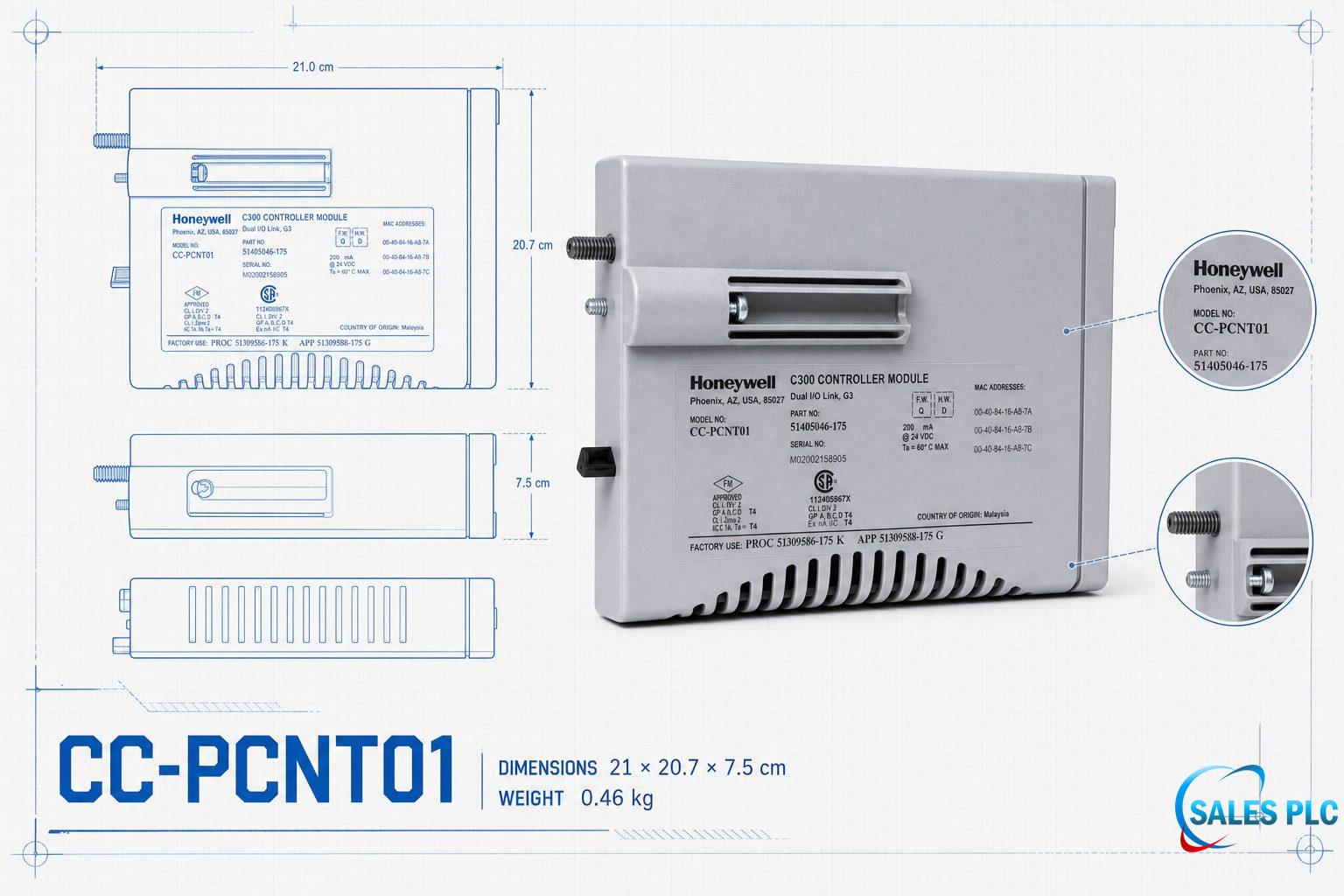
August 2026 — The Honeywell CC-PCNT01 51405046-175 C300 Controller is receiving fresh attention from engineers, maintenance managers, and buyers responsible for mature Experion PKS installations. This established controller executes regulatory, sequence, logic, and device-control strategies while linking field I/O, peer controllers, servers, and operator displays.
A Replacement Decision with Production Consequences
In a refinery, chemical complex, LNG terminal, power station, or pharmaceutical plant, a C300 failure can affect an entire unit. CC-PCNT01 sourcing must therefore address controller loading, firmware, Experion release, redundancy, I/O architecture, hardware revision, and migration strategy. A capable industrial automation parts supplier should provide identification evidence and compatibility support, not merely price and delivery.
C300 Architecture Delivers Deterministic Process Control
Two I/O Links and Fault-Tolerant Ethernet
The CC-PCNT01 is the C300 control processor, with 51405046-175 used as the associated part number. Honeywell’s C300 capacity documentation identifies Fault Tolerant Ethernet as its control network and provides two I/O links.
In the standard 50 ms Control Execution Environment, the controller can use a 375 Kbaud PM I/O link or a 750 Kbaud Series C I/O link. Device indexes are configurable from 1 through 510, while SNTP and PTPv2 provide synchronized time references for alarms, events, historian records, and sequence analysis.
Control Resources Must Be Engineered, Not Estimated
For the 50 ms configuration, Honeywell documents 5,500 Execution Units for user control, I/O, and communications, plus 14,852 Memory Units of CEE user memory. Module execution periods range from 50 ms to 60 seconds.
Communication limits include 2,500 parameter-access responses per second, 4,000 subscribed parameters, and 3,000 reads or 1,500 writes per minute. These figures represent capacity ceilings rather than recommended continuous operating targets. Engineering teams must model CPU, memory, display, peer-to-peer, and I/O demand with adequate spare capacity.
Redundancy Strengthens Process Availability
Redundant control uses two IOTAs and an Ethernet STP redundancy cable. For a 50 ms CEE, Honeywell specifies a nominal 500 ms control-processing switchover interruption and up to 240 seconds for initial synchronization.
Network or I/O-link conditions can extend the interruption, so redundancy should not be described as mathematically “zero downtime.” Honeywell’s brand advantage lies in coordination: CEE scheduling, FTE communications, peer data, I/O, diagnostics, and operator access work as integrated automation and control components within Experion PKS.
Process Industries Continue to Depend on the CC-PCNT01
Refineries, LNG Plants, and Chemical Units
Refinery duties include crude and vacuum distillation, hydrotreating, catalytic reforming, blending, tank transfer, flare monitoring, and utility control. LNG and gas-processing plants may use C300 controllers for inlet separation, dehydration, compression, refrigeration, boil-off gas management, and fiscal or process metering.
Chemical applications include reactor temperature regulation, feed-ratio loops, distillation columns, solvent recovery, and batch sequencing. The 50 ms execution base suits process-control applications where repeatability, alarm context, and coordinated sequences matter more than sub-millisecond machine motion.
Power, Pharmaceutical, and Infrastructure Applications
Power-generation applications include boiler auxiliaries, fuel systems, water treatment, emissions equipment, and balance-of-plant controls. Pharmaceutical facilities may use Experion strategies for clean utilities, environmental systems, formulation, and batch-support operations, subject to applicable validation procedures.
Pulp and paper mills, mines, and water-treatment plants can apply C300 nodes to pumps, chemical dosing, filtration, steam systems, and material-handling interfaces. The CC-PCNT01 is not a safety logic solver or a dedicated CNC, robotics, servo, or inverter controller. Those functions require an appropriately certified safety or motion-control platform.
Honeywell’s Installed-Base Advantage
For existing Experion users, Honeywell’s primary advantage is architectural continuity across control strategies, operator displays, alarm management, historian connections, peer references, and maintenance practices. This continuity can reduce the engineering risk associated with an unplanned conversion to an unrelated control platform.
However, continuity does not mean indefinite like-for-like replacement. Honeywell states that CC-PCNT02 replaced CC-PCNT01 for field replacements. Its June 2026 System Hints bulletin also describes migration from CC-PCNT01/02 to the newer CC-PCNT05 platform. Maintenance teams should compare an exact spare, a planned controller upgrade, and wider system modernization according to total outage risk—not purchase price alone.
Procurement Checks and Recommended Honeywell
The Nameplate Is the Starting Point
A compliant RFQ should state CC-PCNT01, 51405046-175, required quantity, destination, and installed Experion release. Buyers should request nameplate photographs, hardware revision, serial number, firmware information, condition, test report, warranty, ESD packaging, and dead-on-arrival terms.
The commercial offer must distinguish unused surplus, refurbished, repaired, and previously operated units. Engineering should also confirm the IOTA, control firewall, redundancy partner, device index, cable arrangement, I/O-link type, configuration backup, and approved switchover procedure.
Related Models for a Practical Spares Package
Related Honeywell automation parts available in the SalesPlcAuto catalog include:
32-channel 24 VDC Digital Input Module
32-channel 24 VDC Digital Output Module
These are related product candidates, not automatic substitutes or universally compatible companion modules. Before ordering, engineers must verify module keying, termination assemblies, Series C or Series 8 architecture, field power, channel type, hardware revision, firmware, and Experion software support.
Broader MRO Supply Still Requires Technical Discipline
Purchasing departments often consolidate Honeywell automation parts with PLC Systems spare parts, HMI displays spare parts, Servo Drives parts, CNC Systems parts, Robotics parts, Motors and Encoders, and Inverter Drives.
A broad automation spare parts catalog can simplify vendor management, but it does not replace configuration control. Sales teams should obtain the end user’s complete bill of materials and application details before proposing an alternative, especially where process availability, hazardous-area certification, cybersecurity, or validated production records are involved.
Conclusion
A Spare Controller and a Lifecycle Decision
The Honeywell CC-PCNT01 remains relevant because many Experion PKS plants still depend on its deterministic control, dual I/O connectivity, FTE integration, synchronized timing, and redundant architecture.
For engineers, the priority is confirming system loading and selecting a technically safe replacement or migration path. For procurement teams, the priority is traceability, revision accuracy, test evidence, warranty, and delivery risk. For sales departments, the strongest proposal combines the correct controller with verified supporting modules and transparent lifecycle guidance.
That approach turns a difficult-to-source component into a defensible reliability plan rather than a short-term spare-parts purchase.
Request Pricing and Technical Verification
For availability, a formal quotation, product photographs, or compatibility review, please contact:
Contact: Frida