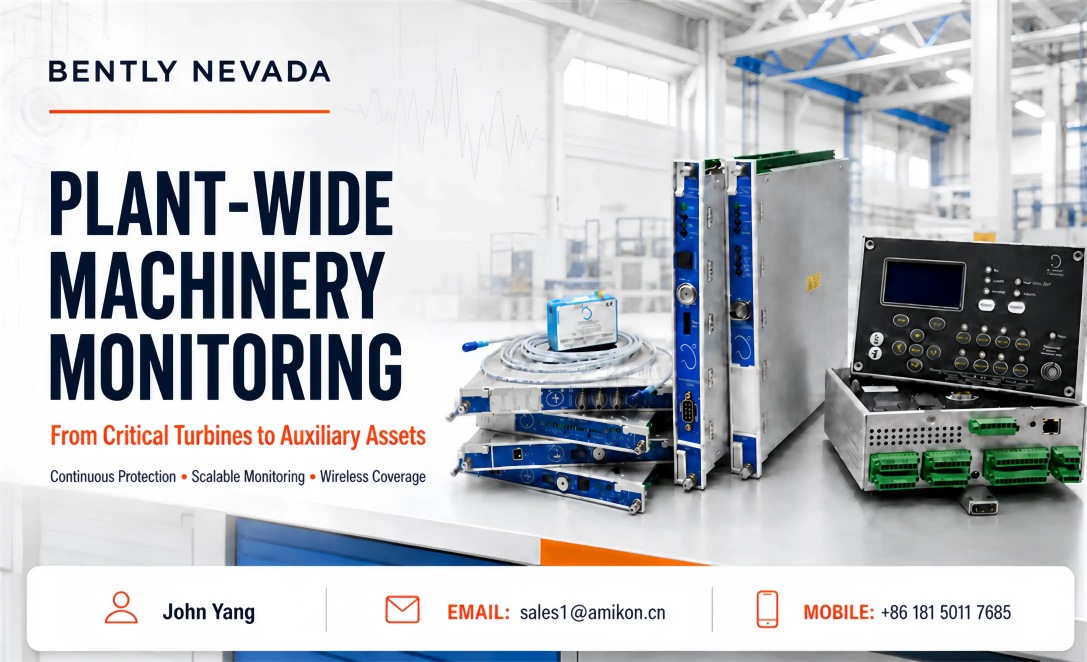
PLANTWIDE MACHINERY MONITORING From isolated protection to connected asset health A tiered Bently Nevada strategy brings critical turbines, essential auxiliary equipment, and dispersed assets into one scalable monitoring environment. Critical assets Continuous protection Essential equipment Scalable wired monitoring Dispersed machinery Flexible wireless coverage IN THIS ARTICLE Tiered strategy · Trendmaster Pro · Ranger Pro · System 1 · Suggested products 01Introduction For decades, machinery protection strategies in process plants concentrated primarily on high-value rotating equipment. However, a modern industrial facility contains far more than a few critical machine trains. Cooling tower fans, heat exchanger fin fans, auxiliary pumps, blowers, motors, gearboxes, and other balance-of-plant assets may number in the hundreds or thousands. Individually, these machines may not justify a dedicated high-end protection rack. Collectively, however, their failures can create significant maintenance costs, process instability, safety exposure, and lost production. Bently Nevada is addressing this monitoring gap through a tiered asset-health strategy. Trendmaster Pro provides scalable, permanently installed monitoring for essential equipment, while Ranger Pro wireless sensors extend coverage to dispersed, difficult-to-wire, and hazardous-area assets. Together with System 1 condition monitoring software, these technologies allow plants to expand machinery visibility beyond the central turbine hall. TECHNOLOGY AT A GLANCE Technology Best suited for Monitoring role 3500 Series Critical machinery High-speed continuous protection Trendmaster Pro Essential auxiliary assets Scalable permanently installed scanning Ranger Pro Dispersed or hazardous-area assets Wireless vibration and temperature monitoring System 1 Plantwide reliability teams Unified analysis, trending, and decision support 02Moving Beyond a Critical-Machinery-Only Strategy Traditional machinery protection systems are designed for assets with high failure consequences and rapidly developing fault modes. Applying the same architecture to every small pump or fan is rarely economically practical. As a result, many auxiliary machines have historically depended on periodic manual inspections. A technician may visit each asset with a portable vibration analyzer once a month or once a quarter. Although route-based data collection remains valuable, it provides only a snapshot of machine condition. Faults that develop between inspections can remain undetected, especially when staffing limitations cause routes to be delayed or shortened. A tiered strategy assigns monitoring technology according to asset criticality, failure behavior, accessibility, and business consequence. The 3500 Series continues to protect critical machinery, while scanning and wireless solutions provide more economical condition monitoring for medium-criticality assets. This approach increases plantwide coverage without treating every ...
View More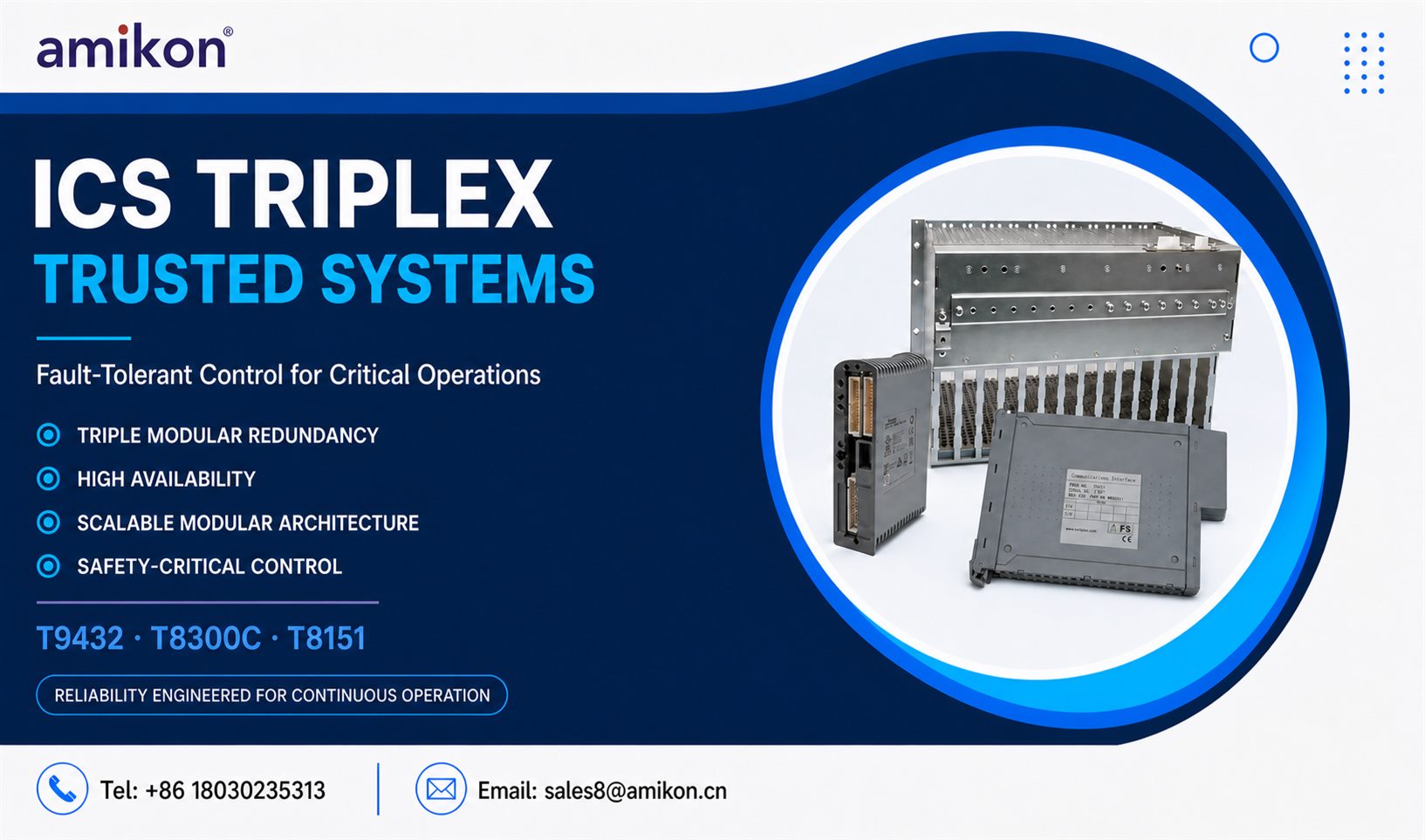
ICS Triplex • Procurement Guide 2026 Verify the complete system fit — not merely the number on the front panel. SalesPLC Trusted module inventory prepared for compatibility review and supply. Careful handling and visual verification help reduce compatibility risk before shipment. When an ICS Triplex module is urgently required, finding a part with a matching front-panel number may appear to be enough. In practice, safety-system procurement requires a much more detailed review. Two Trusted modules may look almost identical while differing in signal type, channel count, operating voltage, hardware series, coating option, field termination arrangement or software compatibility. Selecting the wrong version can delay installation, require additional engineering work or leave the replacement module unusable in the intended system. This guide explains how to understand common ICS Triplex Trusted T8000 model numbers, identify the information needed before ordering and develop a more reliable spare-parts strategy for critical safety applications. Why ICS Triplex Module Selection Requires a System-Level Approach The Trusted system is not a conventional standalone PLC platform. It is a fault-tolerant safety instrumented system based on Triple Modular Redundant, or TMR, architecture. Within the Trusted architecture, three processing paths operate in parallel. A majority-voting mechanism identifies differences between the three paths, reports discrepancies and helps contain hardware faults before they affect overall system operation. Rockwell Automation describes the platform as being designed to support both safety integrity and high system availability. Because of this architecture, an individual module must be considered as part of the complete configured system. The correct replacement depends not only on the visible product code, but also on: 01Controller & chassis Confirm the installed chassis and controller configuration. 02System function Identify the module’s exact role within the safety system. 03Field signals Check signal type, channel count and field-device requirements. 04Hardware & firmware Record the complete series, revision and firmware details. 05Field termination Match the associated FTA, cable and connector arrangement. 06Communication architecture Review installed communication interfaces and expansion topology. 07Safety certification Confirm all required safety and hazardous-area approvals. A purchasing decision based only on an abbreviated model number can therefore introduce unnecessary compatibility risk. Understanding the Main Trusted T8000 Product Groups Trusted T8000 model numbers become easier to understand when they are divided according to their role within the system. Controller, Chassis and Communication Modules At the system-control level, commonly referenced models include the T8111 main processor, T8100 processor chassis, T8151 and T8151B communication modules, and the T8153 communication interface adapter. Expansio...
View More


Visit us
32D Guomao Building, No.388, Hubin South Road, Siming District
Please read on, stay posted, subscribe, and we welcome you to tell us what you think.
Disclaimer : Salesplcauto sells new and surplus products and develops channels for purchasing such products. This website has not been approved or recognized by any of the listed manufacturers or trademarks. Salesplcauto is not an authorized distributor, dealer, or representative of the products displayed on this website. All product names, trademarks, brands, and logos used on this website are the property of their respective owners. The description, explanation, or sale of products with these names, trademarks, brands, and logos is for identification purposes only and is not intended to indicate any association with or authorization from any rights holder.
Copyright @2026 SalesPlc Limited. Sitemap
/ Blog
/ XML
/ Terms And Conditions
/ Privacy Policy
 Network Supported


About Us
Reliable Industrial Automation Parts, Global Supply Support SALES PLC works with a broad network of qualified suppliers to provide industrial automation components that meet our customers’ requirements for quality, availability, price, and delivery time. Our product portfolio covers PLC, DCS, HMI, control systems, safety systems, drives, communication modules, and other critical spare parts from leading brands, including Siemens, Emerson, Invensys Triconex, HIMA, GE, ABB, Honeywell, and Bently Nevada. More Than Products — Complete Supply Solutions Our strength goes beyond product sourcing. We work closely with end users, system integrators, maintenance teams, and industrial partners to identify suitable replacement parts and practical procurement solutions. Through integrated purchasing and online support, customers can send inquiries and place orders throughout the year. Our experienced team responds quickly and helps reduce downtime caused by unavailable or obsolete equipment. Our Team Our experienced team brings together product specialists, sourcing professionals, sales consultants, and customer service staff. We work together to provide clear communication and dependable support at every stage of the order. Growing Together for More Than 20 Years For more than 20 years, SALES PLC has continued to grow with the support and trust of customers, suppliers, and business partners around the world. Every project, inquiry, and partnership has helped us improve our service. Looking ahead, we remain committed to providing dependable products, responsive communication, and professional industrial automation solutions. Thank you to every customer and partner who has supported our journey. We look forward to building a stronger and more successful future together. Sustainable Partnerships SALES PLC believes in building long-term, mutually beneficial relationships with customers and suppliers. We focus on honest communication, responsible sourcing, continuous improvement, and reliable service. As industrial technology continues to evolve, we keep expanding our product knowledge and supplier network to support new systems, legacy equipment, and replacement-part requirements. Contact SALES PLC Our team is available during working hours to answer your questions, check product availability, and prepare a quotation.
Where to Find Us
 32D Guomao Building, No.388, Hubin South Road, Siming District
 +86 18150117685
 sales1@amikon.cn
Follow Us