August 2026 — Industrial operators are reviewing the condition of aging governor systems as power reliability, emissions control and maintenance lead times become increasingly important. The Woodward 8290-184 has consequently returned to the attention of engineers responsible for diesel generator sets, turbine-driven equipment and packaged mechanical systems. This 24 VDC electronic speed control belongs to the Woodward EPG electrically powered governor family and is designed for isochronous operation with compatible 524 or 1724 actuators. Its continuing relevance reflects a practical reality: replacing a proven control component is often less disruptive than redesigning the complete prime-mover control architecture.
A governor problem can prevent a standby generator from accepting load, destabilize a pump drive or extend the restart time of an essential utility package. For maintenance and procurement departments, the 8290-184 is therefore not simply another item among general automation spare parts. It is part of the closed-loop control path between the magnetic pickup, speed controller, actuator and fuel linkage. Correct identification matters because voltage, control mode, pickup-frequency range, actuator capacity, fuel type and starting strategy must agree with the installed equipment.
The Woodward EPG architecture combines an electronic speed control, a magnetic pickup and an electrically powered actuator. During operation, the magnetic pickup supplies a signal proportional to prime-mover speed. The controller compares that feedback with the selected speed reference and adjusts actuator position to correct the error. According to Woodward Product Specification 04106, part number 8290-184 is a 24 VDC isochronous controller for diesel or turbine applications using a 524 or 1724 speed-control actuator. The associated standard 24 VDC actuator references include 8256-021 for Model 524 and 8256-016 for Model 1724.
The nominal 24 VDC input has a documented operating range of 20 to 32 VDC, with maximum power consumption specified at 95 W. Woodward calls for a battery charger capable of at least 5 A while the governor is energized and a 10 A slow-blow fuse or circuit breaker in the non-grounded battery lead. The magnetic pickup must provide at least 1.5 Vrms and typically 100 Hz during cranking. These details are important when investigating difficult starting, speed hunting or intermittent actuator response: replacing the controller will not correct an undersized power supply, poor grounding, weak pickup output or excessive cable voltage drop.
The standard 8290-184 reference covers a magnetic-pickup range of 3000 to 6000 Hz. This figure describes electrical feedback frequency, not shaft speed in revolutions per minute. Engineers must calculate pickup frequency from ring-gear tooth count and rotational speed before approving a spare. The controller typically maintains a steady-state speed band of ±0.25% of rated speed, while an internal 25-turn potentiometer sets the rated-speed reference. Optional external arrangements can provide idle adjustment from 25% to 100% of rated speed and speed trim of ±2.5% or ±5%, depending on the selected potentiometer.
The most familiar application is a diesel generator operating in a hospital, data center, water-treatment plant, mining facility, cement works or manufacturing plant. In an isolated generator set, isochronous governing helps restore engine speed after a step load and maintain nominal frequency once the transient has settled. The 8290-184 also includes an adjustable start-fuel limit. It restricts the maximum actuator position until the engine reaches approximately 95% of the selected speed, helping reduce startup smoke and the risk of excessive acceleration. The limit is re-established after pickup frequency falls to 5% of rated speed or below.
EPG systems are also relevant to diesel- or turbine-driven pumps, compressors and other mechanical loads where speed affects flow, pressure or process output. Crude-transfer pumps, emergency firewater packages, pipeline booster stations, compressor skids and remote utility systems can impose very different inertia and fuel-linkage characteristics. The 8290-184 provides gain and stability adjustments so commissioning engineers can match governor response to the prime mover. Adjustment should be performed from recorded baseline settings and under controlled loading, because excessive gain can produce oscillation while insufficient gain may lead to slow recovery and unacceptable speed droop during a disturbance.
The strength of Woodward automation parts is not limited to the controller enclosure. The brand developed the speed controller, actuator and associated governing accessories as coordinated automation and control components. Compatible accessories can extend an isochronous EPG installation to generator synchronization, load sensing, controlled loading, import/export control or process regulation. The controller’s cast-aluminum construction, approximate 0.5 kg weight and documented –40 to +75 °C control temperature range also suit engine-skid installation. The associated EPG actuators are specified for a broader –40 to +93 °C ambient range, although actual site qualification must consider the complete enclosure, wiring and surrounding heat sources.
Before issuing a purchase order, the buyer should request photographs of the nameplate, terminal area and complete assembly. The technical review should confirm 8290-184, 24 VDC supply, isochronous mode, start-fuel-limit requirement, 3000–6000 Hz pickup range and the installed 524 or 1724 actuator. Procurement teams should also record the engine or turbine model, rated speed, flywheel tooth count, fuel-linkage direction, governor travel, existing speed-trim circuit and generator operating mode. A droop controller, gas-engine version or position-feedback driver may look related but is not automatically a functional substitute.
A capable industrial automation parts supplier should provide identification photographs and information about condition, revision and packaging before shipment. Once received, the module should be checked for enclosure damage, corrosion, disturbed adjustment seals, loose terminals and inconsistencies between the quotation and nameplate. Commissioning personnel should retain the original gain, stability, rated-speed and fuel-limit settings before removing the installed controller. Insulation, continuity and power-quality checks should be completed before energization, by a controlled no-load start and documented load-step test.
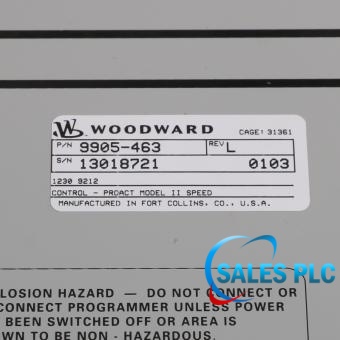
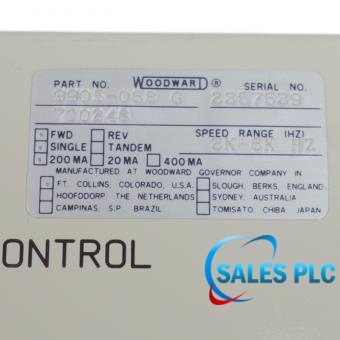
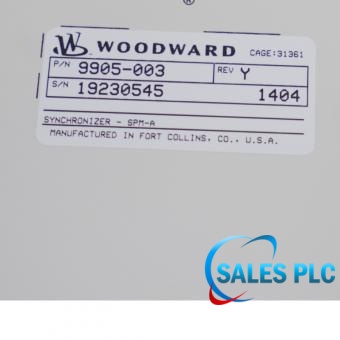
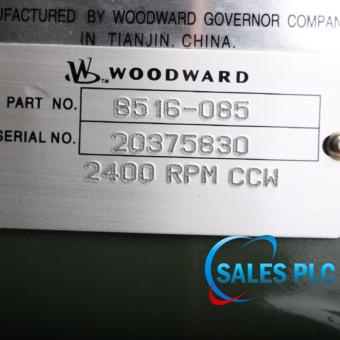
The SalesPlcAuto product catalog also lists several related Woodward modules for power-generation and turbine-control inventories:
For consolidated MRO purchasing, the same sourcing program may cover PLC Systems spare parts, Servo Drives parts, HMI displays spare parts, CNC Systems parts, Robotics parts, Motors and Encoders, and Inverter Drives. These categories should remain separated by system family in the technical evaluation, even when combined into one commercial enquiry.
The Woodward 8290-184 remains valuable where a functioning EPG installation needs a correctly matched speed-control replacement. Its 24 VDC input, isochronous governing, adjustable dynamics, start-fuel limiting and compatibility with 524 or 1724 actuators make it relevant to generator sets and process prime movers that cannot tolerate uncontrolled speed variation. However, successful replacement depends on engineering evidence rather than visual similarity. Pickup frequency, actuator type, wiring, linkage travel, supply capacity and operating philosophy must all be verified.
For availability, product photographs, identification review or a formal quotation, please contact:


Visit us
32D Guomao Building, No.388, Hubin South Road, Siming District
Please read on, stay posted, subscribe, and we welcome you to tell us what you think.
Disclaimer : Salesplcauto sells new and surplus products and develops channels for purchasing such products. This website has not been approved or recognized by any of the listed manufacturers or trademarks. Salesplcauto is not an authorized distributor, dealer, or representative of the products displayed on this website. All product names, trademarks, brands, and logos used on this website are the property of their respective owners. The description, explanation, or sale of products with these names, trademarks, brands, and logos is for identification purposes only and is not intended to indicate any association with or authorization from any rights holder.
Copyright @2026 SalesPlc Limited. Sitemap
/ Blog
/ XML
/ Terms And Conditions
/ Privacy Policy
 Network Supported


About Us
Reliable Industrial Automation Parts, Global Supply Support SALES PLC works with a broad network of qualified suppliers to provide industrial automation components that meet our customers’ requirements for quality, availability, price, and delivery time. Our product portfolio covers PLC, DCS, HMI, control systems, safety systems, drives, communication modules, and other critical spare parts from leading brands, including Siemens, Emerson, Invensys Triconex, HIMA, GE, ABB, Honeywell, and Bently Nevada. More Than Products — Complete Supply Solutions Our strength goes beyond product sourcing. We work closely with end users, system integrators, maintenance teams, and industrial partners to identify suitable replacement parts and practical procurement solutions. Through integrated purchasing and online support, customers can send inquiries and place orders throughout the year. Our experienced team responds quickly and helps reduce downtime caused by unavailable or obsolete equipment. Our Team Our experienced team brings together product specialists, sourcing professionals, sales consultants, and customer service staff. We work together to provide clear communication and dependable support at every stage of the order. Growing Together for More Than 20 Years For more than 20 years, SALES PLC has continued to grow with the support and trust of customers, suppliers, and business partners around the world. Every project, inquiry, and partnership has helped us improve our service. Looking ahead, we remain committed to providing dependable products, responsive communication, and professional industrial automation solutions. Thank you to every customer and partner who has supported our journey. We look forward to building a stronger and more successful future together. Sustainable Partnerships SALES PLC believes in building long-term, mutually beneficial relationships with customers and suppliers. We focus on honest communication, responsible sourcing, continuous improvement, and reliable service. As industrial technology continues to evolve, we keep expanding our product knowledge and supplier network to support new systems, legacy equipment, and replacement-part requirements. Contact SALES PLC Our team is available during working hours to answer your questions, check product availability, and prepare a quotation.
Where to Find Us
 32D Guomao Building, No.388, Hubin South Road, Siming District
 +86 18150117685
 sales1@amikon.cn
Follow Us